Friday, August 12, 2011

King Solomon’s “Navy” ( Kings 9:26)

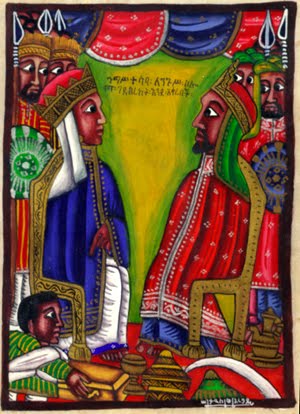
On what sea did Solomon build his fleet? The Red Sea (I Kings 9:26)

King Solomon’s “navy” was built in Ezion-geber on the shores of the Red Sea (I Kings 9:26). The fleet is listed in a compendium of his accomplishments that convey Solomon’s splendor (I Kings 9:10-28; II Chronicles 9:13-28). Though the ASV and KJV speak of a “navy”, the Hebrew ’oniy is better rendered by the more common “fleet of ships” (ESV, HCSB, NASB, NKJV, NLT, NRSV, RSV). The MSG and NIV (“ships”) and CEV (“a lot of ships”) simply avoid the term.

Solomon’s navy was not military or imperialistic in nature but rather a commercial fleet. Ironically, perhaps the only time that Israel ever experienced peace was at a time they employed a successful “navy”. Solomon’s fleet completed three year expeditions to import all types of exotic cargo including gold, silver, ivory, apes, and peacocks (I Kings 10:22; II Chronicles 9:21).

Though the Israelites are often thought of more as sea fearers than seafarers, they do have some history on the seas. There is a reference in “Deborah’s Song” that indicates that the tribe of Dan was closely identified with maritime activities (Judges 5:17). After Solomon, King Jehoshaphat unsuccessfully attempted to get into the shipping industry (I Kings 22:48; II Chronicles 20:36-37). The only time the Israelites have been known to excel on the waters, however, was done at the time of Solomon. His Red Sea fleet could sail to African, Asian and Pacific ports and he also used an additional port in Tarshish (I Kings 10:22; II Chronicles 9:21).

Israel’s maritime success during Solomon’s reign was predominantly due to his alliance with King Hiram of Tyre (I Kings 9:10-14). Solomon’s friendship with Hiram allowed him to get a foot in the Phoenicians’ monopoly on the ancient world’s sea routes as Hiram sent seasoned sailors to teach the Israelites (I Kings 9:27; II Chronicles 8:18). In aligning with Hiram and establishing his own fleet, Solomon cut out the middle man and became a player in the lucrative maritime trade business.

Solomon was said to have been the wisest man of his time. How is Solomon’s wisdom displayed in his maritime interests? Was his alliance with Hiram a wise one? Why? Why not?

Solomon’s reign begins by him being granted any wish by God (I Kings 3:5). When Solomon chooses an “understanding heart” (I Kings 3:9 NASB), God adds “I have also given you what you have not asked, both riches and honor, so that there will not be any among the kings like you all your days (I Kings 3:13 NASB).” God fulfilled that promise in spades.

Tony Campolo (b. 1935) famously asks “Would Jesus Drive a BMW?” Is there a limit to the wealth a Christian should accumulate? Why?

“But seek first His kingdom and His righteousness, and all these things will be added to you.” - Jesus, Matthew 6:33, NASB

Thursday, August 11, 2011

The Wisdom of Ants (Proverbs 30:24)

“Though they be little on earth, they are exceedingly wise.” To what does this refer? Ants (Proverbs 30:24).

Ants appear only twice in the Bible, both times in the Book of Proverbs being lauded for their wisdom (Proverbs 6:6-8, 30:24-25). Ants are one of the world’s oldest living creatures and have not changed much since the time of Solomon. The global ant population is estimated at 10,000 trillion, greatly outnumbering any other animal. Proverbs 6:6 commands “Go to the ant, O sluggard,/Observe her ways and be wise (Proverbs 6:6 NASB).”

It is a command few have taken professionally as there are fewer than 500 myrmecologists (ant scientists) in the world. Bert Hölldobler (b. 1936) and E. O. Wilson (b. 1929) won the 1991 Pulitzer Prize for their book, The Ants. They lament that ants “run much of the terrestrial world as the premier soil turners, channelers of energy, dominatrices of the insect fauna — yet receive only passing mention in textbooks on ecology (Hölldobler and Wilson, The Ants, 1).”

What have you learned from watching animals? Have you ever observed ants? What is it that made Proverbs deem ants models of wisdom?

Ants are exhorted for their diligence, their initiative without supervision, and their foresight. Proverbs most certainly had economics in mind when venerating ants as each time they appear in the Bible, reference is made to their preparing food in the summer (Proverbs 6:7, 30:25). In the summer, ants accumulate as much food as possible to be eaten during the fall and spring, when they reside underground. (Ants generally hibernate in winter.) This economic strategy fits Proverbs as elsewhere the book advises not to spend all one’s income (Proverbs 21:20) and to save for unforeseen circumstances (Proverbs 27:12).

In an admirable effort to be totally dependent on God, popular Christian guru Francis Chan (b. 1967) has no retirement fund or savings account. In his book, Crazy Love: Overwhelmed by a Relentless God (2008), he writes:

“Lukewarm People do not live by faith; their lives are structured so they never have to. They don’t have to trust God if something unexpected happens – they have their savings account. They don’t need God to help them – they have their retirement plan in place. They don’t genuinely seek out what life God would have them live – they have life figured and mapped out. They don’t depend on God on a daily basis – their refrigerators are full and, for the most part, they are in good health. The truth is, their lives wouldn’t look much different if they suddenly stopped believing in God (Chan, Crazy Love: Overwhelmed by a Relentless God, 76) .”
Chan then goes on to discuss the Parable of the Rich Fool (Luke 12:16-21). There is quite a discrepancy between the standard interpretation of Proverbs and Francis Chan’s financial strategy.

Should Christians save money? What does your budget say of your priorities? Where do you draw the line between faith in God and prudence?

The address “O sluggard” in Proverbs 6:6 (NASB) indicates that the wisdom gleaned from the ant also relates to work ethic. Ants are such diligent workers that a myth has developed that they do not sleep. It cannot be determined whether ants “sleep” in the way humans do. They do not possess eyelids so they cannot close their eyes. They do rest, but trying to monitor their brain activity would interfere with it so much that the results would be inconclusive. It is known that ants do look for food only during the day and that in the winter, their breathing and metabolism slows considerably. Do you work as hard as you should?

Much of ants’ success as a species is attributed to cooperation and task sharing within the context of sophisticated hierarchical social structures. Ants work in teams to move extremely heavy things, capture prey, and they can summon extra workers when an abundant food source is discovered or the colony is in need of defense. Ants can also adapt their duties to overcome an unforeseen problem. In The Lives of Ants (2009), Laurent Keller (b. 1961) and Elisabeth Gordon explain that the key to ants’ society is communication through the use of pheromones emitted by secretory organs. Hölldobler and Wilson commend this as “the most complex forms of chemical communication among animals (Hölldobler and Wilson, The Ants, 1).” These transmissions explain how though single ants are not clever, collectively they are capable of complex tasks. What tasks do you work on with fellow Christians?

One final way in which ants display wisdom is that though each ant has a distinct function, all work collectively towards a singular goal. This is strikingly similar to Paul’s likening the Christian life to functioning as part of the Body of Christ (Romans 12:4-5; I Corinthians 10:17, 12:12-27; Ephesians 1:22-23, 3:6, 4:4-16, 5:30) . All ant species live in colonies centered around one or more egg-laying “queens”. Whereas ants work for a queen, Christians should all be working for a common King.

Have you found your role in the body of Christ?

Wednesday, August 10, 2011

The Revelation of Cleopas (Luke 24)

What was Jesus doing when Cleopas and his friend recognized Jesus? Breaking bread (Luke 24:30, 31).

One of the last stories Luke’s gospel records tells of two disciples’ encounter with the resurrected Jesus on the road to the village of Emmaus, a town unnamed elsewhere in Scripture (Luke 24:13-35). A man named Cleopas (Luke 24:18) and an unnamed companion were dejectedly discussing the events of the crucifixion and skeptically analyzing the reports of the empty tomb when Jesus joined the sad cynics. They were not privy to their new associate’s identity as “their eyes were prevented from recognizing Him (Luke 24:16 NASB)”. En route, Jesus explained the correlations between the crucifixion and the messiah (Luke 24:26-37) and then at their request ate with them in Emmaus (Luke 24:29-30). It was whilst dining that “their eyes were opened and they recognized Him (Luke 24:31 NASB)”. This revelation made them reinterpret the facts and they went from seeing Jesus as “prophet” (Luke 24:19) to viewing him as “lord” (Luke 24:34).

Cleopas is an abbreviated form of Cleopatros, a common Hellenistic name meaning “son of a renowned father”. The name does not appear elsewhere in the New Testament as only Luke tells this story, but Cleopas is often linked with Clopas (John 19:25). If Cleopas and Clopas are synonymous, then Cleopas’ wife was one of the women present at the cross. That conclusion seems to be supported by a comment that Cleopas makes to Jesus - “some women among us amazed us (Luke 24:22 NASB).”

The fact that Cleopas is named indicates that he was likely known to the early church. Church historian Eusebius (263-339) states that Simeon, son of Clopas, succeeded James as bishop of Jerusalem. Early Christian Hegesippus (110-180) says that Cleopas was Joseph’s brother, making him Jesus’ uncle. Jesus’ own uncle may have failed to recognize him.

Have you ever not recognized a loved one when seeing them in an unexpected setting? What was it about Jesus that made him indistinguishable? Who or what prevented their eyes from seeing and likewise who opened their eyes? Aside from listening to “Take on Me”, have you ever had an A-ha moment where something came together for you?

The revelatory moment came not in the exposition of the Scriptures but during the breaking of bread. Whether it was the way that Jesus broke the bread, or the disciples seeing the nail prints in his hands, or it was simply God’s time for their eyes to be opened is unclear. Somehow, in eating with Jesus, the two travelers glean his identity. Many have made a connection between this and Christians taking the Lord’s Supper.

Cleopas and his friend hustled back to Jerusalem in the dark to share their good news with their fellow disciples (Luke 24:33-35). Theirs was a powerful testimony of the resurrected Jesus by two credible eyewitnesses.

Why did it take the breaking of bread to open their eyes? What was the advantage in the delayed recognition? If you have ever had a revelatory moment, did you share your revelation?

Be known to us in breaking bread,
But do not then depart;
Savior, abide with us, and spread
Thy table in our heart.
- James Montgomery (1771-1854), “Be Known to Us in Breaking Bread”.

Tuesday, August 9, 2011

Hanging Haman High (Esther 7:10)

Who was hanged on a gallows he built for someone else? Haman (Esther 7:10)

The Book of Esther is the story of the titular character becoming queen of Persia and saving the Jewish people from genocide at the hands of Haman. Haman has gigantic gallows built on his own property for the sole purpose of hanging his perceived rival, Esther’s uncle, Mordecai (Esther 5:14, 6:4). Ironically, it would be Haman himself who was hung on these gallows (Esther 7:9-10).

Haman the Agagite is a villain straight out of central casting. He was an honored official in King Ahasuerus’ court (Esther 3:1) whose vendetta against Mordecai began when the Jew cited his religious beliefs as reason not to kneel before Zod Haman (Esther 3:2, 4, 5). In response, Haman decided not only to punish Mordecai but to extinguish the entire Jewish race (Esther 3:6, 8). Like many villains, Haman is motivated by pride and viewed Mordecai’s religious convictions as an affront to his self value. Full of his own self importance, Mordecai’s defiance ate at him so much that no matter what blessing was given him, Haman could not be content as long as Mordecai lived (Esther 5:9, 13). Mordecai’s very presence represented that Haman’s importance in the eyes of others was imperiled.

As the comic villain might do, Haman constructs a unique weapon to eliminate his enemy. Haman does not simply construct gallows (Esther 5:14, 6:4), but gallows that are fifty cubits (75 feet) tall (Esther 5:14, 7:9)! This brings new meaning to the expression “hang ’em high”. Haman planned to make Mordecai an object lesson for all to see.

In his book The Key: How to Write Damn Good Fiction Using the Power of Myth, James N. Frey (b. 1943) identifies five characteristics of the villain: big headed, an outlaw, clever and resourceful, may be wounded, and may have great sex appeal. He adds that the villain is often motivated by greed, vanity, or lust for power, has self-serving motives, never acts out of idealism, is often cruel, may win by luck (which never happens to the hero), is not forgiving, might quit, may whine and grovel, may turn on friends and followers, is not usually physically superior (though a sidekick might be) and has no special birth or destiny though may claim one.

In what ways does Haman fit into James Frey’s characterization of an epic villain? Compare and contrast Haman and Adolf Hitler (1889-1945). Why was Haman thwarted so quickly and Hitler allowed to cause so much destruction?

In the end, Haman’s plans are foiled, God’s people are saved and the archetypical villain is hanged on his own instrument of death. Haman’s poetic demise seems to embody karma, a foundational principle in Hindu and Buddhist teachings. Karma is a system of moral reaction applied to both good and evil actions i.e. what goes around comes around. Reincarnation and the caste system hang upon the principle of karma.

Christianity agrees with a general ideas of cause/effect and personal responsibility. Paul writes that “for whatever a man sows, this he will also reap (Galatians 6:7, NASB).” He also says “For we must all appear before the judgment seat of Christ, so that each one may be recompensed for his deeds in the body, according to what he has done, whether good or bad (II Corinthians 5:10, NASB).” Jesus’ parable of the Rich Man and Lazarus (Luke 16:19-31) also echoes these sentiments (Luke 16:25).

Conversely, Jesus also says that God “causes His sun to rise on the evil and the good, and sends rain on the righteous and the unrighteous (Matthew 5:45 NASB)” and that the first will be last and the last will be first (Matthew 19:30, 20:16; Mark 10:31; Luke 13:30). History is replete with examples of righteous sufferers.

In what ways is karma compatible with Christianity? In what ways is it not? Are grace, mercy, and atonement ever compatible with karma?

In Mark Jesus is said to have been a tekton (Mark 6:3), a builder which almost all translations render “carpenter” (ASV, CEV, ESV, HCSB, KJV, MSG, NASB, NIV, NKJV, NLT, NRSV, RSV). Could Jesus have built crosses? Could he have hung from a gallows that he built?

Monday, August 8, 2011

Madness of King Nebuchadnezzar (Daniel 4)

What king went mad and ate grass like an ox? Nebuchadnezzar.

Nebuchadnezzar II (634-562 BCE), king of the Neo-Babylonian Empire, is remembered as one of history’s great leaders. In the Bible, he is known simply as Nebuchadnezzar and portrayed less favorably. Daniel depicts Nebuchadnezzar as an arrogant ruler who demanded worship of himself (Daniel 3:4-6). Daniel relays that at the height of his power, God humbled the monarch.

The fourth chapter of Daniel contains a first person account of Nebuchadnezzar’s dream of a great tree cut down to size (Daniel 4:13-17), Daniel’s interpretation explaining that Nebuchadnezzar would lose his faculties (Daniel 4:19-27) and the fulfillment of that analysis one year later (Daniel 4:28-37). The text shifts from first person to third person to accent that the story is out of the king’s control. After the condition subsides, Nebuchadnezzar resumes his account in the first person. The chapter ends with Nebuchadnezzar proffering a doxology to God acknowledging God’s supremacy (4:34-37).

Nebuchadnezzar’s insanity was sensational. Six symptoms are relayed: a loss of reasoning (Daniel 4:16), being drenched in the dew of heaven (Daniel 4:15, 25, 33), being exiled with animals (Daniel 4:16, 25, 32, 33), a change in dietary patterns i.e. eating grass (Daniel 4:25, 32, 33), growing hair like eagles’ feathers (Daniel 4:33) and possessing nails like birds’ claws (Daniel 4:33). Nebuchadnezzar’s exile and his lack of hygiene may indicate that the ruler was completely unrestrained. These symptoms persisted for the ambiguous duration of “seven periods of time” (Daniel 4:16, 23, 25, 32). This could mean seven years or seven months but given the number seven’s association with completeness in Hebrew writings, it may simply mean that the length was sufficient to accomplish God’s purpose(s).

Though these symptoms are curious, they are not entirely unique in the annals of history. Using modern psychological terminology, it appears that Nebuchadnezzar represents a textbook case of boanthropy. This is a rare psychological disorder in which a human being believes herself to be a bovine. Dreams are known to play a part in this malady.

British scholar R.K. Harrison (1920-1993) provides the following account from physician Raymond Harris on his experiences with a man suffering from boanthropy in a British mental institution in 1946:

A patient was in his early 20’s who reportedly had been hospitalized for about five years. His symptoms were well developed on admission, and diagnosis was immediate and conclusive. He was of average height and weight with good physique, and was in excellent bodily health. His mental symptoms included pronounced anti-social tendencies, and because of this he spent the entire day from dawn to dusk outdoors, in the grounds of the institution... His daily routine consisted of wandering around the magnificent lawns with which the otherwise dingy hospital situation was graced, and it was his custom to pluck up and eat handfuls of the grass as he went along. On observation he was seen to discriminate carefully between grass and weeds, and on inquiry from the attendant the writer was told the diet of this patient consisted exclusively of grass from hospital lawns. He never ate institutional food with the other inmates, and his only drink was water…The writer was able to examine him cursorily, and the only physical abnormality noted consisted of a lengthening of the hair and a course, thickened condition of the fingernails.” (Harrison, Introduction To the Old Testament, 1116)
Not surprisingly, psychologists have long been intrigued by the case of Nebuchadnezzar. Cognitive psychologist Henry Gleitman (b. 1925) speculates that Nebuchadnezzar exhibited features of an advanced syphilitic infection (Gleitman, Psychology, 219).

Famed psychiatrist Carl Jung (1875-1961) addressed Nebuchadnezzar in many of his works. He diagnosed the arrogant ruler with a “classic case of megalomania” (Jung Collected Works, volume 8, ¶ 163). Jung analyzed Nebuchadnezzar’s dream writing that it was “easy to see that the great tree is the dreaming king himself. Daniel interprets the dream in this sense. Its meaning is obviously an attempt to compensate the king’s megalomania which, according to the story, developed into a real psychosis” (Jung, Dreams, 37). This reading views the dream as an exemplar of a compensatory dream, a dream by which the dreamer offsets a disproportionate sense of power. Nebuchadnezzar’s vision of the tree being cut is what his psyche deemed must happen for him to achieve any semblance of wholeness. Whether or not one consents to Jung’s interpretation, his summary of Nebuchadnezzar’s condition is seemly - “a complete regressive degeneration of a man who has overreached himself.” (Jung, Analytical Psychology 123).”

Many critics have argued the historicity of the events as depicted in Daniel due to their unbelievable nature. There is also some discussion as to whether or not the government could have maintained itself with its leader decommissioned. King George III, “the Mad King” of Great Britain (1738-1820) and Ronald Reagan (1911-2004), the 40th U.S. president who likely suffered from Alzheimer’s disease during his presidency, have shown that an effective staff can run a government with a sidelined figurehead. Nebuchadnezzar was known for selecting an elite staff as evidenced by the process by which he selected Daniel (Daniel 1:3-7).

Critics also argue that there is no outside evidence to support the Biblical account. This is not entirely true. There is a conspicuous absence of any record of acts or decrees by Nebuchadnezzar from 582 -575 BCE (Gleason L. Archer, Jr. [1916-2004], Expositor’s Bible Commentary: Volume 7, 63). Berossus, a Babylonian priest and astronomer of the third century BCE, documents that Nebuchadnezzar became suddenly ill after 43 years in power (Contra Apionem 1:20). Eusebius (263-339) cites a report from the Greek historian Abydenus that corroborates the Biblical account stating that in Nebuchadnezzar’s latter days he was “possessed by some god or other (Eusebius, Praparatio Evanelica 9:41).” Also, a clay tablet housed in the British Museum known as BM34113 (lines 3,6,7,11,12,14) describes Nebuchadnezzar exhibiting irregular behavior including noting that “his life appeared of no value to him (Kendall K. Down [b. 1949], Daniel: Hostage in Babylon, 30). It has also been argued that an Aramaic fragment excavated from Qumran Cave 4 in 1952 attributed to Babylon’s last king, Nabonidus (556-539 BCE), is actually a garbled tradition relaying the illness of Nebuchadnezzar (Archer, Expositor’s Bible Commentary: Volume 7, 63).

The reader is not intended to have sympathy for the foreign dictator. Does Daniel have compassion for the king? Does the prophet’s interpretation of the dream influence (or even cause) Nebuchadnezzar’s breakdown? How should we treat the mentally ill?

Nebuchadnezzar is dehumanized. He is said to eat grass like a bovine, grow hair like an eagle and nails like a bird (Daniel 4:25, 32, 33). The implication is clear - Nebuchadnezzar becomes less than human. No other human eats grass in the Bible and to eat grass like a bovine may even have been a colloquialism as it is used with three different nouns all meaning bovine: showr (Numbers 22:4, Psalm 106:20), baqar (Job 40:14), and the Aramaic, towr, found only in Daniel (Daniel 4:25, 32, 33, 5:21). In temporarily dehumanizing the arrogant ruler, God removed Nebuchadnezzar’s power.

Do you feel God’s treatment of Nebuchadnezzar was just? When have you been humbled? Have you ever felt humbled by God?

The point of the passage is seen in the fact that Nebuchadnezzar’s illness lasts “until you [Nebuchadnezzar] recognize that the Most High is ruler over the realm of mankind and bestows it on whomever He wishes (Daniel 4:25, NASB).

God is the true king and to defy God is madness.

Friday, August 5, 2011

Lot: A Slow Boiled Frog (Genesis 13:12)

Where did Abraham’s nephew, Lot, move after separating from his uncle? To Sodom.

When Abraham (then Abram) journeyed to the land that God would show him (Genesis 12:1), he took his late brother Haran’s son, Lot, along (Genesis 12:4). Both prospered and eventually the land was not big enough for the both of them (Genesis 13:6). Their hired hands began feuding (Genesis 13:7) and Abraham decided to resolve the conflict by dividing the land and allowing Lot to choose his portion (Genesis 13:8-9). Lot saw the fertility of the land to the east in the Jordan valley and selected it (Genesis 13:10-11). It seemed like a good idea at the time.

Each time Lot’s location is reported thereafter, his contiguity to the city gates of Sodom is closer. Lot begins in the vicinity of Sodom (Genesis 13:12), becomes a resident (Genesis 14:12) and eventually is seen sitting at the gate, a place of prominence (Genesis 19:1). From the outset, Sodom’s citizens are appraised as “exceedingly wicked” (Genesis 13:13 NASB) and Lot slowly became one of them.

How did you choose where you live? Were there any moral considerations?

It is said that if a frog were to be put into a cauldron of boiling water, it would instinctively leap to escape danger. Conversely, if placed in a pleasant kettle and gradually boiled, frogs would not relocate as their survival instincts are geared towards detecting sudden changes. The analogy of a slow boiling frog has become a widespread anecdote used to illustrate the need for awareness of slowly changing trends as well as the obvious sweeping changes.

The metaphor is based on study conducted by A. Heinzmann in 1872 which encompassed examining 27 frogs. Heinzmann planned to heat decapitated and brain damaged frogs with only one of their legs in the water. He progressed to an arrangement where the frog was seated on a cork floating in a cylinder of water. Heinzmann then elevated the temperature of the frog’s habitat from 21° (Celsius) to 37.5° over the course of 90 minutes. Eventually, Heinzmann advanced to working with undamaged frogs. In his twelfth trial, a healthy frog was boiled from 23° to 39° without any movement though the amphibian could have freely escaped throughout the experiment if it so chose. Heinzmann successfully replicated the results in two of his next three trials. He then reproduced the experiment with freezing temperatures. (Heinzmann [1872], “Ueber die Wirkung Sehr Allmäliger Aenderungen Thermischer Reize auf die Empfindungsnerven”, Archiv fur die Gesammte Physiologie, Bd. VI, 222-236)

Though Heinzmann’s findings were corroborated by C. Fratscher in 1875, today, modern scientists refute Heinzmann’s findings. Whether true or not, the analogy of the slow boiled frog conveys truth as evidenced by Lot’s story. Lot was “righteous” (II Peter 2:7) and yet his association with Sodom ruined his life. Through his residing in the doomed city, his wife died (Genesis 19:26) and when he is last seen in the Biblical text, he is involved in a drunken, incestuous relationship with his own daughters (Genesis 19:30-38). “Righteous” Lot’s downfall began by moving closer and closer to the “exceedingly wicked”.

Are you in danger of becoming a slow boiled frog in any aspect of your life?

Thursday, August 4, 2011

Job’s Fairy Tale Ending (Job 42:14)

How many daughters did Job have? Six [3 before his testing and 3 after his testing] (Job 1 and 42)]

Job had the ideal life. He was “was blameless, upright, fearing God and turning away from evil (Job 1:1, NASB).” Job had an abundant family with seven sons and three daughters, the ancient Hebrew equivalent of 2.4 kids (Job 1:2). Job was also rich. The Bible goes to great lengths to enumerate his possessions (Job 1:3). Then the calamity for which he is known occurred and he lost all of his holdings (Job 1:14-17) and children (Job 1:18-19). After his redeemer came, Job’s story concludes with a fairy tale ending in which Job and his family live happily ever after. An inventory of his resources after his restoration shows that his assets have doubled since before his trial (Job 42:12). In contrast, though his family is rebuilt, Job has the same number of children at the end of the story as when it began (Job 42:13). The 2:1 rectification ratio does not work when dealing with human life. The implication is that life is irreplaceable.

Job’s story also takes a subtle yet radical turn after his renewal as his daughters, not his sons, move to the forefront. Before the crisis, Job’s sons represent the vanguard. They held feasts on their birthdays and invited their sisters (Job 1:4). After the crisis, uncharacteristically, the focus is on the women, not the men, of Job’s family. Job’s seven sons remain unnamed and no comment is made about them (Job 42:13) while his three daughters are all named and extolled (Job 42:14-15). In fact, of his 20 children, Job’s last three daughters are the only ones named in the Biblical text. Their names were Jemimah, Keziah, and Keren-happuch (Job 42:14).

He named the first Jemimah, and the second Keziah, and the third Keren-happuch. (Job 42:14 NASB)
The text not only names Job’s daughters but also discusses them. Fitting with Job’s fairy tale ending, his daughters were the fairest women in all the land (Job 42:15). Job also provided his daughters with not just a dowry, which would later transfer to a husband, but an inheritance, an income that belonged to them alone (Job 42:15). This allowed Job’s daughters self sufficiency which was highly irregular in a time period when women and men were not treated equally (Numbers 27:1-8). As such, Job’s daughters have become associated with female equality.

Why are Job’s second set of daughters named? What about his trials would change Job’s relationship to his daughters? What prompted their inheritance?

Norman C. Habel (b. 1932) speculates that Job’s providing his daughters with an inheritance is indicative of his character. He writes, “By giving his daughters an inheritance with their brothers Job demonstrates that he continued a policy of justice and equity in his life which went beyond the normal practice of the ancient world (Job 31). In Israel, for example, a daughter would only inherit the property of her father if there was no male heir (Numbers 27:1-8).” (Habel, The Book of Job: A Commentary (Old Testament Library), 585)

Job is deemed “blameless” and “upright” and to be so entails a concern for the poor and oppressed. Job’s actions foreshadow the equality that Paul would preach.

There is neither Jew nor Greek, there is neither slave nor free man, there is neither male nor female; for you are all one in Christ Jesus. (Galatians 3:28, NASB)
That women should receive an equal inheritance is a relatively modern thought. There are still realms where equality is not practiced. When, if ever, should a double standard exist between men and women?
“The best judge of whether or not a country is going to develop is how it treats its women. If it’s educating its girls, if women have equal rights, that country is going to move forward. But if women are oppressed and abused and illiterate, then they're going to fall behind.” - Barack Obama (b. 1961), Ladies’ Home Journal, September 2008

Wednesday, August 3, 2011

Reservations for Mansions or Rooms?

Complete: “In my Father’s house are many _________________; if it were not so, would I have told you that I go to prepare a place for you? Rooms of mansions (John 14:2).

On the night that he was arrested, Jesus comforted his disciples by assuring them they he was leaving to prepare a place for them (John 14:1-4). He adds that in his father’s house are many “rooms” or “mansions” depending upon the translation (John 14:2). In modern English, this is quite a discrepancy.

What real estate is in question? Which do you prefer? Why?

The more appealing “mansion” originates with the King James Version (KJV) in 1611 and has been adopted by the ASV (1901) and NKJV (1979). John 14:2 marks the only time “mansion” appears in the KJV. This opulent imagery has become prominent from its use in the KJV and countless hymns (“Mansion Over the Hilltop”; “A Mansion in Glory”; “An Empty Mansion”; etc.).

The KJV’s English Bible predecessors do not use the word “mansion”. John Wycliffe’s New Testament (1385) reads “dwelling” and its successors, the Geneva Bible (1560, “dwelling places”) and the Bishops’ Bible (1568,“dwelling places”) follow suit. Most modern translations opt for “dwelling places” (HCSB, NASB, NRSV) or “rooms” (CEV, ESV, NIV, RSV).

These readings fit the context of being located within a house and are also truer to the Greek word used, μονή (moné), which indicates nothing of structure, whether lavish or humble. It means “a staying, abiding, dwelling, abode.” or “to make an (one’s) abode.” This word is used only twice in the New Testament, both times in John 14 (John 14:2, 23). In the latter passage, even the KJV translates the word “abode”. The word is common in extant Greek literature appearing in the Apocrypha, Philo (22 BCE-50 CE), and Josephus (37-100), and always indicates an “abode”. The common verb related to the Greek noun in question, meno, famously employed by Jesus in John 15:4-7, is typically translated “abide”. Neither word suggests luxury.

The KJV was likely influenced by the most famous Latin translation, the Vulgate, which uses the word mansiones, the plural of mansio, in John 14:2. Mansio means “a remaining, stay, sojourn; station, halting place.” In 1611, when the KJV was first published, the English word “mansion” did in fact refer to a dwelling place. The KJV is not incorrect, the language has simply changed through the centuries.

Two modern versions avoid the debate by summarizing what the text means. The New Living Translation (1996) reads that there is “plenty of room” and The Message (1993-2002), Eugene Peterson’s paraphrase, claims that there is “more than enough room”. These renditions present the passage’s intent and convey very good news. There will be room at the inn.

Does it matter to you whether you have a room or mansion prepared for you? Is there room for everyone?

For a day in Your courts is better than a thousand outside.
I would rather stand at the threshold of the house of my God Than dwell in the tents of wickedness. (Psalm 84:10, NASB)

Note: This post is indebted to Doug Kutilek’s article “A ‘Mansion’ over the Hilltop?”.

Tuesday, August 2, 2011

Isaac & Rebekah: Opposites Attract

Which woman won a rich husband by offering to water a stranger’s camels? Rebekah (Genesis 24:20).

Abraham sent an unnamed servant, presumably Eliezer of Damascus (Genesis 15:2), on a mission to acquire a wife for his son, Isaac, with the explicit caveat that the woman not be a Canaanite (Genesis 24:1-9). The servant left with ten camels and when he arrived at his destination prayed that the woman who agreed to give him water would also agree to water the camels as a sign that she was the woman he was to select (Genesis 24:10-14). Before his prayer is even completed ,it was answered as Rebekah appeared and watered the camels (Genesis 24:15-20). Rebekah would return with the servant and marry Isaac (Genesis 24:67). Whether or not Isaac was a prize to be “won” is up to the reader.

When have you prayed for a sign? Have you ever prayed for a very specific sign and received it?

This story is a prominent example of what Robert Alter labels a Biblical “type scene”, a story that recurs in the Biblical text. In the Bible, men often travel to a foreign land to procure a wife at a well. This is not surprising as many people today go to “watering holes” in hopes of attracting the opposite sex. This is the first time the motif appears. Isaac, (Genesis 24:10-20), Jacob (Genesis 29:9-10), and Moses (Exodus 2:16-17) all meet their wives at wells in strange lands. Alter suggests that Saul’s excursion for his father’s camels is an aborted version of this type scene (I Samuel 9:11-12). This paradigm also illuminates the story of Jesus meeting the woman at the well (John 4) as like an Old Testament betrothal scene, Jesus, as the divine Bridegroom (Matthew 9:15; Mark 2:19-20; Luke 5:34-35), encounters a woman (John 4:7) at a well (John 4:6) in an alien land (John 4:5), and discusses her marital status (John 4:16-17).1

In type stories, since the essential plot points are the same, the devil is in the details. The differences are accentuated and therefore significant. In Isaac’s case, Isaac is the only character who does not go to the well himself. Not only is a surrogate sent, but Isaac does not even commission the intermediary. This illustrates Isaac’s character as he is consistently depicted as passive. Isaac is typically the character acted upon, not the one performing the actions.

In contrast, Rebekah is a worker. She offers to go the extra mile and water the stranger’s camels. In just three short verses, 12 verbs are used of Rebekah (Genesis 24:16, 18-20). Some have found great humor in this text, as camels were not domesticated at the time this story occurred. This would mean that Rebekah was running around like a chicken with her head cut off. Whether or not the camels were domesticated, Rebekah works at a frenetic pace. She worked. Isaac did not.

In the case of Isaac and Rebekah, opposites attracted and the match was a good one. When Isaac saw Rebekah, he loved her (Genesis 24:67). This is the first time the word “love” is used in the Bible of a couple.

When discussing marriage, Jesus says, “What therefore God has joined together, let no man separate (Matthew 19:6 NASB; Mark 10:9 NASB ).”

If you have one, where did you meet your significant other? Was God involved in the meeting? Are all marriages ordained by God? What experiences have influenced your beliefs on the subject?

1Robert Alter, The Art of Biblical Narrative. (New York: Basic Books, 1981) 51-60.

Monday, August 1, 2011

Malchus: Beloved Enemy

What was the name of the servant who had his ear cut off at the time of Jesus’ betrayal? Malchus.

All four gospels record that when Jesus was seized, one of his disciples impulsively lopped off the ear of one of the arresting party (Matthew 26:51-52; Mark 14:47; Luke 22:49-51; John 18:10-11). Only in John’s gospel are the disciple (Peter) and the victim (Malchus) named (John 18:10). Some have suggested that John is able to name names because the involved parties were dead at the time of publication and no longer in danger of retribution. John’s account emphasizes Malchus’ name by deliberately adding the clause “and the slave’s name was Malchus” (John 18:10, NASB). Malchus is one of only two people healed by Jesus (not counting the resurrected Lazarus) to be named in Scripture (Mark 10:46; John 18:10).

Peter faced a crisis when Judas identified Jesus for arrest in Gethsemane (Matthew 26:49; Mark 14:45; Luke 22:7-48; John 18:1-5). Not thinking that Jesus’ story should take this turn, the impetuous disciple assumed that somebody had to do something. When faced with fight-or-flight response, Peter drew his sword to fight (Matthew 26:51; Mark 14:47; Luke 22:49-50; John 18:10). His blow severed Malchus’ ear. Luke and John specify that the right ear was lost (Luke 22:50; John 18:10), a fact that may indicate that Peter was left-handed as facing one another, Malchus’ right ear would be on the side of Peter’s left hand. Peter may have simply been an inept swordsman. Either way, Peter missed his target as he almost certainly was not trying to amputate an ear but rather to behead an enemy. In his mind, this was not a criminal act of murder, but a military act of war.

Malchus was a natural target. He was the symbol of authority, the servant of the priest orchestrating the arrest (Matthew 26:51; Mark 14:47; Luke 22:50; John 18:10). The grammar implies Malchus was the representative from the high priest in this scenario. Malchus means “counselor” or “king”. Ironically, he may have severed as the high priest’s eyes and ears during the arrest.

Have you ever acted impulsively because you thought somebody ought to do something? What would you have done if you were Peter? If you made the choice to attack, who would you have targeted? Why did Peter attack Malchus instead of Judas?

Peter’s assault of Malchus would likely have a started melee had Jesus not intervened because the culture advocated reciprocal justice, “an eye for an eye”, an ear for an ear (Exodus 21:24; Leviticus 24:20; Deuteronomy 19:21; Matthew 5:38). Jesus makes it clear that though Peter is a fighter, Jesus is a lover. Jesus restores Malchus’ ear (Luke 22:51) and rebukes his advocate (Matthew 26:52; Luke 22:51; John18:11). Interestingly, only Luke notes that the ear was healed (Luke 22:51). Jesus hits the undo button and nullifies the harm that his charge had done. Mending Malchus would be Jesus’ last recorded miracle during his earthly life. In healing Malchus, Jesus saved Malchus from maiming and Peter from retribution.

Peter’s sword gave Jesus the opportunity to perform one last act of love as a savior to the world that would murder him. Jesus’ healing of Malchus in the midst of being arrested radically demonstrated his teaching to “love your enemies” (Matthew 5:44; Luke 6:27, 35). It also knocked down the disciples’ last bastion of building an empire by force. Jesus never used violence. Unfortunately, there is occasionally a disconnect between Jesus and his followers and Christians have been known to utilize brute force.

Does Jesus ever need defending by violence? If so, when? When have Christ’s followers hurt you? How much of Christ’s work in the world is undoing the harm his followers have caused? How many Malchus’ ears caused by bold Peters has Christ not healed?

Malchus might have served as Jesus’ escort to the high priest. As the servant of one high priest and the patient of another (Hebrews 2:17, 3:1, 4:14, 15, 5:10, 6:20, 8:1, 9:11), Malchus was left to choose which high priest he would serve. The Bible leaves his decision open ended though the fact that his name lives on may be some indication of his choice.

Friday, July 29, 2011

The Original Mary and Rhoda

In which city did Rhoda live? Jerusalem (Acts 12:13)

In 44 CE, Herod Agrippa I (10 BCE-44 CE) targeted the nascent Christian movement. He had the apostle James beheaded and Peter arrested (Acts 12:2-3). This barrage represented a crisis to the early Christians and they began to pray (12:5). On the night of his arraignment, an angel busted Peter out amidst heavy security (Acts 12:6-11). Free, Peter made his way to a safe house in Jerusalem owned by Mary, the mother of John Mark (Acts 12:12). He was stopped at the door by Rhoda, who recognized his voice, announced him, but in her excitement failed to admit him (Acts 12:13-14). Ironically, Peter, who is often pictured as the doorkeeper to heaven, is prevented from entering by a gatekeeper. Finding the news too good to be true, the contingent of believers assembled do not believe Rhoda’s story, but that it her story and she sticks to it (Acts 12:15).

Have you ever known you were right when seemingly everyone assumed you were wrong? Did you waiver?

Rhoda and Mary were the names of two best friends featured on the iconic television series The Mary Tyler Moore Show (1970-1977) played by Valerie Harper and Mary Tyler Moore respectively (pictured). Much like a Jewish home owner and Gentile servant, the two characters in the program are very different from one another. Many of the scenes involving Rhoda also feature the faceless expressionless voice of Carlton the doorman who presents Rhoda with decisions as to who to let up to her apartment. It is unknown if the characters’ names were influenced by the Biblical text.

The jail break marks the only time Rhoda appears in the Bible (Acts 12:13). Her name is Gentile in origin and means “Rose” or “woman from Rhodes”. She is described as a paidiske. This word means “young girl” or “maid servant” which is reflected in most translations: “maid” (ASV, NRSV, RSV), “servant girl” (ESV, NASB, NLT), “servant” (CEV, HCSB, NIV), “damsel” (KJV), “girl” (NKJV),“young woman” (MSG). Rhoda is the only paidiske named in the New Testament.

Rhoda is the first to receive the good news of Peter’s freedom. Her fellow Christians seem shocked that their prayer has actually been answered. Are you ever surprised when your prayers are answered?

The story bares many striking resemblances to another instance in Peter’s life - the night he denied Christ in the high priest’s courtyard (Matthew 26:69-76; Mark 14:66-72; Luke 22:56-62; John 18:17-18, 25-27). In each story, Peter is attempting to hide from someone but is recognized by his voice, not his appearance (Matthew 26:73; Acts 12:13). In both instances, he is identified by a servant girl (the same word, paidiske, Matthew 26:69; Mark 14:66, 69; Luke 22:56; John 18:17; Acts 12:13). In each case, the girl consistently confirms her identification in the face of opposition from a disciple or disciples. In fact, the word used for “insist”, diischurizomai, only occurs only in Luke-Acts and only in relation to these two stories (Luke 22:59; Acts 12:15).

Have you ever experienced déjà vu? Compare and contrast the two stories in Peter’s life. What point, if any, is Luke trying to make by using such similar vocabulary? What progress has been made in Peter’s life from one instance to the next?

Thursday, July 28, 2011

Moses: You Can Look, But You Can't Touch

Why was Moses not allowed to go into the Promised Land? Because he struck the rock to cause water to come forth when he had been told to speak to the rock. [Disobedience] (Numbers 20:12)

Moses led the Israelites out of Egyptian slavery in pursuit of the Promised Land. Tragically, though he guided the people for forty years, Moses was not permitted to enter the Promised Land. Before dying atop Mount Nebo, Moses was allowed to glimpse a panoramic view of the land his people would inherit (Deuteronomy 34:1-6).

On the surface, the reason for his exclusion is simple. The Israelites were without water in the wilderness of Zin (Numbers 20:1-3). God instructed Moses to speak to a rock and extract water (Numbers 20:8). Moses successfully distilled water from the rock but instead of speaking to it, he struck the rock twice (Numbers 20:11). Moses did what God commanded but in the course of executing the directive, he did not use the proper method. As a result, it was decreed that Moses must die in the desert without entering the Promised Land (Numbers 20:12).

While the incident that kept Moses from the Promised Land is clear, the nature of the sin that warranted such an extreme penalty is far more ambiguous. Thirty-nine years earlier, the Israelites were in a similar predicament and God instructed Moses to strike a rock to produce water (Exodus 17:6). This indicates that the issue is not striking the rock but rather Moses’ rationale behind it. The sin is said to be one of pride. This is seen as Moses announces in front of all of Israel, “Listen now, you rebels; shall we [Moses and Aaron] bring forth water for you out of this rock?” (Numbers 20:10, NASB). Moses took credit for God’s handiwork.

In the midst of detailing the Israelites’ past rebelliousness, Psalm 106 claims that Moses was provoked and that “he spoke rashly with his lips (Psalms 106:33, NASB).” This implies that Moses’ words were as much an issue as his actions. Moses’ attitude is also revealed when recounting the incident. Instead of taking responsibility, he seemingly blames the people for his not making the cut into Canaan stating, “The LORD was angry with me also on your account, saying, ‘Not even you shall enter there.’ (Deuteronomy 1:37, NASB).”

Is the penalty too harsh? Does it fit the crime? Is Moses, as leader, held to a higher standard? Do you give God credit where credit is due? Why didn’t Moses simply follow God’s instructions?

There may be a practical reason for Moses’ being left in the desert - he may have completed his part of the mission. Moses led primarily through miracles and this was not how the land of Canaan was to be conquered. Though there are miraculous facets to the conquest of the Promised Land, it required standard warfare. Joshua, Moses’ successor, proves a very apt general. Moses could not have been seen as anything but a leader and his presence may have detracted from Joshua’s command. Some have concluded that it would not have been fitting for the law giver (Moses) to lead the way into the Promised Land.

Great leaders often do not live to see their work completed. Most of Christianity’s great doctrines emerged after their supporters were dead and often after they lost their lives in the battle. Jesus’ vision of the kingdom of God was not completed in his lifetime.

What task will you undertake that you could or would not do without God? What mission will you accept for God that cannot be finished in your lifetime?

As a postscript, after the indiscretion, God still loves Moses so much that God handles Moses’ burial (Deuteronomy 34:6). Years later, Moses later appears to Jesus and three of his disciples on the Mount of Transfiguration, a mountain located squarely within the confines of the Promised Land (Matthew 17:3; Mark 9:4; Luke 9:30).

Wednesday, July 27, 2011

Pharisees: Blind Leading the Blind

Who were the “blind guides”? Scribes and Pharisees (Matthew 23:24)

Jesus is often presented in contrast to the religious leaders of his day. The Pharisees, a prominent Jewish sect, are frequently his antagonists. The New Testament presents the Pharisees as rigidly enforcing the letter of the law and Jesus living by its Spirit. As the Pharisees were in a position of leadership, Jesus referred to them unflatteringly as “blind guides” (Matthew 15:14, 23:16, 24). In the latter references, the scribes are grouped with the Pharisees.

The idiom of the blind leading the blind does not originate with Jesus, though the English expression likely comes from the King James Version’s translation of Jesus’ words. The Katha Upanishad, a Hindu text written hundreds of years before Christ, also uses the saying. It reads, “Abiding in the midst of ignorance, thinking themselves wise and learned, fools go aimlessly hither and thither, like blind led by the blind.” The metaphor of the blind leading the blind has come to speak of any leader who knows no more about her mission than her charges.

The only Biblical instances where “blind guides” have a specific point of reference occur in the Gospel of Matthew (Matthew 15:14, 23:16, 24). In Luke, Jesus presents the term “blind guides” in the “Sermon on the Plain” but uses it in general terms (Luke 6:39). The first time Jesus uses the expression to brand his critics transpires in a private session with his disciples (Matthew 15:12-14) but the second time it appears, he makes the claim public (Matthew 23:1-32).

Jesus never uses the word “blind” in relation to someone with a physical condition, but always to describe his adversaries’ spiritual predicament. Jesus emphasizes this in a series of woes in his last discourse in Matthew (Matthew 23: 16, 17, 19, 24, 26). In John, the Pharisees ask sarcastically if Jesus considers them blind. He responds, “If you were blind, you would have no sin; but since you say, ‘We see,’ your sin remains (John 9:41, NASB).”

Have you ever seen a group or organization where the blind were leading the blind? What did the Pharisees not see that made Jesus label them as “blind”?

Jesus openly criticizes the religious leaders of his time. He viewed the religious experts’ role as that of a guide. Guides are not above reproach.

How do you view the role of ministers? If you had to compare a minister’s job to one thing, what would it be? Do you perceive any modern religious officials to be blind guides?

“Evangelism is one beggar telling another beggar where he found bread.” - Sri Lankan evangelist D.T. Niles (1908-1970)

Tuesday, July 26, 2011

Prophetesses: Then. And Now?

Which women in the New Testament were prophetesses? Anna (Luke 2:36); 4 daughters of Philip (Acts 21:9)

The Bible makes no distinction between the prophetic ministry of men and women. Eleven Biblical women are deemed to be prophetesses: Miriam (Exodus 15:20), Deborah (Judges 4:4), Huldah (2 Kings 22:14; II Chronicles 34:22), Noadiah (Nehemiah 6:14), Isaiah’s unnamed wife (Isaiah 8:3), Anna (Luke 2:36-38) and the four daughters of Philip (Acts 21:9). Of the five New Testament prophetesses, all appear in Luke-Acts and only one is named, Anna (Luke 2:36).

Little is said of Anna. She was a devout 84-year old widow who spent her time in the temple (Luke 3:36). She was there when the infant Jesus was brought to be circumcised, praised God and thereafter spoke about the Lord “to all those who were looking for the redemption of Jerusalem (Luke 2:38, NASB).”

Less is said of Philip’s daughters than Anna. Only their existence as virgins and prophetesses is acknowledged (Acts 21:9). Technically speaking, they are not deemed prophetesses. Though the NASB uses the word “prophetess” in relation to them, most translations accurately say that they prophesied (ASV, CEV, ESV, HCSB, KJV, MSG, NIV, NKJV, NLT, NRSV, RSV). The fact that these women prophesied does not require the conclusion that they were deemed prophetesses. Other women might be said to have prophesied, such as Mary (Luke 1:48) and Elizabeth (Luke 2:41-45), but were not considered prophetesses.

The stories of the five New Testament prophetesses cover a total of only four verses (Luke 2:36-38; Acts 21:9) and in none of them does the prophetess do anything particularly noteworthy. Nor are any direct quotes attributed them.

What does it mean to be a prophetess? What do you think caused these women to be seen as prophetesses?

The role of prophetess is not clearly defined and the New Testament does not teach of an office of prophetess. It is clear that women did and were intended to prophesy in the New Testament era. Peter pronounces at Pentecost that women would prophesy (Acts 2:18) and Paul teaches that women who prayed or prophesied ought do so with their heads covered (I Corinthians 11:5).

Though many definitions abound as to what it means to be a prophet, one commonality is that prophecy requires revelation from God. Before one can speak for God, God must first speak to them. Since these women prophesied, the implication is that God spoke to these New Testament women.

If God speaks to women, should God also not speak through women? When has a woman voiced the words of God to you? Have you ever encountered a prophetess?

Monday, July 25, 2011

Ehud: A Cloak and Dagger Story

Who was the judge who was left-handed? Ehud. (Judges 3:15)

The death of Joshua (Judges 1:1) created a leadership vacuum which left the twelve tribes of Israel with no centralized government and susceptible to invasion. Periodically, charismatic leaders known as “judges” arose to give the Israelites a temporary respite from their enemies. Judges were not arbitrators of cases like today but rather more often than not guerilla warriors. Ehud is the second of the six major judges (Judges 3:15-30). His story is vulgar and a tale one would not expect to find in the Bible or to be heard in church.

Eglon, king of Moab, aligned himself with Ammon and Amalek and captured “the City of Palms”, Jericho (Deuteronomy 34:3; Judges 3:13). Jericho had been the Israelites’ first major conquest in the Promised Land (Joshua 6:1-26). Instead of obliterating the Israelites, Moab opted to subjugate them and extract tribute (Judges 3:15). Eglon was morbidly obese (Judges 3:18), presumably at the expense of his subjects. His tyranny endured for eighteen years before Ehud emerged (Judges 3:14).

Having no trained army at his disposal, Ehud devised a plan to assassinate Eglon opportunistically using his position as leader of the couriers that paid the Israelites’ tribute (Judges 3:15). Before leaving on his mission, Ehud fashioned a double-edged sword one cubit (eighteen inches) in length (Judges 3:16). The weapon was innovative for its time as the standard sword was curved with only one sharp edge. The straight sword was designed for stabbing and more importantly for Ehud allowed it to be concealed, unlike its curved counterparts.

Ehud’s left-handedness also aided his deception. In fact, he is the first left-hander mentioned in the Bible (Judges 3:15). This appears to be a genetic trait of his tribe, Benjamin (Judges 3:15, 20:16), which ironically means “son of my right hand” (Genesis 35:18). Being a southpaw, Ehud kept his weapon on his right thigh instead of the usual left. His bare left thigh made him appear unarmed.

Ehud obtained a private audience with Eglon under the auspices of relaying a secret (Judges 3:19). Alone with the king, Ehud thrust his weapon so deep into Eglon’s corpulence that not only the blade but the haft was lodged as well (Judges 3:22). This tactic prevented the immediate spurt of blood which would have alerted the guards. Ehud then locked Eglon in the room and escaped as Eglon’s staff misinterpreted the smell to be that of the king relieving himself (Judges 3:23-24). Before Eglon’s corpse was discovered, Ehud escaped to the mountains of Ephraim where the king’s death served as a rallying cry for Israel who then defeated the Moabites (Judges 3:26-29).

Ehud commits premeditated murder. His action was as risky as a double edged sword. To Moab, Ehud was an assassin but to Israel he was a “deliverer” canonized as a judge (Judges 3:15). Fortunately for him, Israel wrote the history.

Do you feel Ehud is a hero, villain, or something else in between? Why?

Hundreds of years later, another potentially left handed swordsman attempted to do battle for God. When Jesus was being arrested, all four gospels report that a disciple cut off the ear of one of the arresting party (Matthew 26:51-52; Mark 14:47; Luke 22:49-51; John 18:10-11). John identifies the disciple as Peter and the victim as Malchus (John 18:10). It was Malchus’ right ear that was severed, meaning that either Peter was left-handed or a remarkably inept swordsman (Luke 22:50; John 18:1).

Jesus disapproves of the action and offers this aphorism of non-violence:
“Put your sword back into its place; for all those who take up the sword shall perish by the sword.” (Matthew 26:52, NASB)
The contrast between the stories of the swordsmen, Ehud and Peter, demonstrates the radical nature of the kingdom Jesus was establishing.

How is the kingdom of God different from the kingdom of Israel? Could there ever be such a thing as a Christian assassin? If so, under what circumstances?

Friday, July 22, 2011

Aeneas: Walking Witness

Where did Aeneas live? Lydda (Acts 9:33)

Aeneas was a paralytic from Lydda healed by Peter (Acts 9:32-35). Though miraculous, Peter’s healing of Aeneas is overshadowed by the momentous conversion of Paul that precedes it (Acts 9:1-31) and the resurrection of Dorcas that follows it (Acts 9:36-43). In fact, Aeneas’ tale is skipped over in the Revised Common Lectionary, the system of appointed readings in many Christian denominations. As such, Aeneas’ story is relatively obscure.

When Peter traveled through the coastal town of Lydda, he encountered a man named Aeneas who had been incapacitated for eight years (Acts 9:33). In the name of Jesus, Peter healed Aeneas and the paralytic could instantly walk (Acts 9:34). The demonstrable change in Aeneas was enough to convert “all who lived” in the Mediterranean coastal cities of Lydda and Sharon (Acts 9:35). Aeneas was a walking witness to the power of Christ.

Little is known of Aeneas, including the exact diagnosis of his condition. The Greek word used is paraluo (Acts 9:33). This verb is used only five times in the New Testament, four falling in Luke-Acts (Luke 5:18, 24; Acts 8:7, 9:33; Hebrews 12:12). The word is always presented in the passive voice and literally means “to loose from the side”. As such, the term suggests that Aeneas was paralyzed as the result of a disease and not an accident. Some have suggested that he suffered from polio as there is evidence that poliomyelitis had been plaguing the Middle East since at least 1000 BCE. It can be certain that Aeneas was suffering from a chronic condition that was likely progressively deteriorating and presumed to be permanent.

Have you struggled with any problem for as long as eight years? What is the longest you have endured a particular trial? Did you lose hope?

The healing of Aeneas mirrors Jesus’ healing of a paralyzed man in Luke 5:18-26. One glaring commonality is that both Jesus and Peter relieved the formerly ill men of their stretchers (Luke 5:24, Acts 9:34). Their mats were no longer necessary, signs of past lives.

Is there anything you need to put in your past to more effectively follow Christ?

Thursday, July 21, 2011

David's Stones

How many smooth stones did David pick up when he prepared to fight Goliath? Five (I Samuel 17:40)

David’s triumph over the Philistine giant Goliath is one of the most famous Bible stories and the quintessential picture of the victorious underdog (I Samuel 17). The soldier Goliath brings a litany of armory to battle (I Samuel 17:5-7) while the shepherd David carries a humble arsenal.
“He [David] took his stick in his hand and chose for himself five smooth stones from the brook, and put them in the shepherd’s bag which he had, even in his pouch, and his sling was in his hand; and he approached the Philistine.” - I Samuel 17:40, NASB
After testing king Saul’s armor (I Samuel 17:38-39), David adopts a less is more approach and goes with what he knows as battle is not a time for experimentation. He carries only the tools of his trade - a staff, perhaps a decoy to falsely suggest that it would be used to cudgel a sword, and a sling (I Samuel 17:40).

David is very selective in picking his ammo. He waits until reaching a brook to draw the smooth polished rocks that lay in its valley. Smooth stones make superior slingshot pellets as they produce more predictable trajectories and are less apt to get caught on the cradle.

The Bible specifies that David chose five smooth stones (I Samuel 17:40). This proved an excess of four as David needed only one to fell the Philistine giant (I Samuel 17:49).

Why do you think David selected five stones?

No reason is given in Scripture for the spare rocks though many theories have been postulated. The simplest is that of the pragmatist. David could not have carried many stones and the extras provided a contingency plan in the event he missed. Likewise, carrying more than five would be pointless as had he missed five times, he would have already been defeated. Proponents of this explanation laud David for being responsible and not limiting God to a single result. This does not seem to fit the text as lacking confidence is not part of this story (I Samuel 17:26, 32-37). In the terms of today’s youth, David had to have some serious stones to undertake this mission in the first place.

Others speculate that David was preparing for retribution from Goliath’s four brothers. This is based upon II Samuel 21:15-22 and a parallel passage in I Chronicles 20:5. Though the Bible does not specifically state that Goliath had four brothers, he had at least one (II Samuel 21:19). This conjecture also does not fit the context because even if Goliath did have four brothers, it is doubtful that David would have known. David is depicted as shocked by Goliath’s challenge and is seen asking questions about the situation (I Samuel 17:26, 29).

A more likely supposition is that David planned complete obliteration of the enemy. The Philistines controlled five strongholds each led by a lord (Joshua 13:3; I Samuel 6:16, 17, 18). Goliath was the representative of Gath (I Samuel 17:4, 23), one of their five cities.

There are also many metaphorical interpretations. Five appears in Biblical expressions relating to being hopelessly outnumbered (Leviticus 26:8; I Corinthians 14:19). Biblical numerologists cite five as the number of the Bible and suggest that David’s selection represents his using the very word of God to defeat Goliath. In charismatic circles it has been said that five represents the “five fold ministry” of apostle, prophet, evangelist, pastor, and teacher.

None of these hypotheses is wholly satisfying (especially the metaphorical). What is clear is that regardless of how many stones David took into battle, he would have appeared defenseless and overmatched in this contest. David takes a radical alternative and chooses not to play the game by Goliath’s rules. David was the proverbial man taking a knife to a gun fight.

What can Christians use today in handling the challenges they face? What do you take into battle with you?

David takes only five smooth stones and faith to battle a giant. They were enough.

Wednesday, July 20, 2011

An Open Letter to Gaius?

Which book is written to Gaius? III John

III John is addressed to a believer named Gaius (III John 1:1). Before being canonized, III John was simply a letter encouraging Gaius in a dispute with a man named Diotrephes (III John 1:9-11). It also served as a cover letter for Demetrius, whom the author was sending to support Gaius (III John 1:12).

It has been assumed that Gaius was a member of one of the churches in the region of Asia Minor. In the epistle, he is described as an “elder” and “beloved” (III John 1:1). Little else can be said of him with any certainty. Gaius was a common Roman name and appears in four books of the New Testament (Acts 19:29, 20:4; Romans 16:23; I Corinthians 1:14; III John 1:1). Whether or not III John’s Gaius correlates to any of the others is unknown.

III John is one of eight New Testament books addressed to individuals.(Luke 1:3, Acts 1:1, Philemon 1:1, I Timothy 1:2; II Timothy 1:2; Titus 1:4; II John 1:1; III John 1:1).

Do you think these personal letters were intended for public consumption? Why? Why not? What information should be made public?

Christians have the eight New Testament books addressed to individuals because their addressees treated them as open letters. With social networking becoming the norm, much of our information is now public. Correspondence is instantaneous and can be circulated on a grand scale with the click of a button. Like the New Testament, the internet has proven to be a good place to preserve writing.

A 2010 study by Consumer Reports surveyed 2000 households in regards to social media use. Their research showed that 52% (yes, more than half) of the people on social networking sites are posting some form of personal information online that falls under the umbrella of risky social media behavior.

What are you posting online? How do you decide what you post online? Is the lasting effect your writing may have a factor?

Is any of your online writing intended to glorify God? Should it?

Tuesday, July 19, 2011

Queen of Sheba: Fit For a King

Who was the first person in the Bible to arrive by a train? The Queen of Sheba (I Kings 10:2, KJV)

At the height of Solomon’s empire, the Queen of Sheba makes a state visit to Israel (I Kings 10:1-13). She arrives in style. The King James Version (KJV) says she entered “with a very great train” (I Kings 10:2, KJV).
And she came to Jerusalem with a very great train, with camels that bare spices, and very much gold, and precious stones: and when she was come to Solomon, she communed with him of all that was in her heart. (I Kings 10:2, KJV)
Train is not meant in the modern sense as the steam powered vehicles presently associated with the term were not invented until 1804, long after the KJV was first published in 1611.

The word the KJV renders “train” is chayil, meaning “strength, might, efficiency, wealth, army”. “Retinue” is the most common translation (ESV, HCSB, NASB, NKJV, NRSV, RSV) of this word in this text. Other readings are “caravan” (NIV), “group of attendants” (NLT), “several of her officials” (CEV), and the aforementioned “train” (ASV, KJV).

The Queen of Sheba brought an entourage. This is still done in modern state visits where a ceremonial welcome is customary.

Why does the Queen of Sheba bring attendants? Why is there so much pageantry associated with state visits, then and now?

There is a practical reason behind bringing a staff on state visits. In addition to strengthening diplomatic relationships with other countries, another purpose of state visits is to improve bilateral economic relations. Delegations from trade organizations often travel with the visiting head of state in hopes of networking with industry leaders in the visited nation.

The retinue is also evidence of the Queen’s identity and status. She approaches Solomon as a fellow monarch, not a subject. Like the Hebrew chayil indicates, the queen approached the king from a position of “strength”.

She did not travel lightly. In addition to her entourage, she also brought “camels carrying spices, large quantities of gold, and precious stones” (I Kings 10:2, NASB). The Queen of Sheba knew how to make an entrance and a first impression.

How would you prepare to meet a king? What was you bring him? How would you approach him?

“The Queen of the South will rise up with this generation at the judgment and will condemn it, because she came from the ends of the earth to hear the wisdom of Solomon; and behold, something greater than Solomon is here. “ - Jesus, Matthew 12:42 (NASB)

Given Matthew 12:42, a better question might be, how are you preparing to meet a king?

Monday, July 18, 2011

Leah: Beauty is in the Eyes...

Which of Jacob’s wives had eye trouble? Leah (Genesis 29:17)

When Jacob is sent to Paddan-Aram to procure a wife from his mother’s family (Genesis 28:2), he finds his uncle Laban’s two daughters, Leah and Rachel (Genesis 29:16-17). The text introduces the sisters together and provides rare physical descriptions. Rachel, the younger sister, is described straightforwardly as “beautiful of form and face” (Genesis 29:17, NASB). In contrast, elder sister Leah is said to possess “weak” eyes (Genesis 29:17, NASB). With these physical portraits, the reader is presented with the same first impression as Jacob.

If someone were to define your physical appearance for posterity with only one phrase, what would it be? What would you want it to be? Who do you compare yourself to physically? Beauties like Rachel?

Leah’s description is ambiguous. The Hebrew word, rak, means “tender, soft, delicate, weak”. The Septuagint (Greek New Testament) utlilizes the word astheneís meaning “sick, ill, feeble, weak, poorly”. This adjective does not fit neatly with the noun eyes and the meaning of rak may have changed over the centuries. Popular translations are “weak” (ESV, NASB, NIV, RSV), “tender eyed” (ASV, DARBY, KJV, YLT), and “delicate” (HCSB, NKJV). The CEV and NLT interpret that Leah’s eyes “didn’t sparkle” (CEV, NLT).

The translation “weak eyes” has been prevalent since H.F.W. Gesenius (1786-1842) incorporated it into his foundational Hebrew and Chaldee Lexicon to the Old Testament. “Weak” eyes also fits the context as Jacob has just cheated a a man with weak eyes (Genesis 27:1) and he will be deceived later in the chapter for failing to see which woman he married (Genesis 29:22-25).

The designation has traditionally been interpreted as disparaging with the implication that Laban might have had a hard time marrying off his eldest daughter. In this reading, weak eyes is like a modern person describing someone as having a“nice personality”. Gerhard Von Rad (1901-1971) states that fiery eyes were considered the epitome of beauty in this culture and that the verse indicates that Leah’s eyes lacked luster and as such detracted from her beauty. 1 The Jewish historian Josephus (37-100) puts it bluntly - “she was of no comely countenance (Antiquities, I, xix, 7).”

Given the uncertain intent, some modern interpreters and translators have taken this clause to be complimentary, a case of synthetic instead of antithetical parallelism. This reading may have some merit as nowhere else in Scripture is rak used in a demeaning manner or with reference to a defect. The Message reads that Leah had “nice eyes” (MSG) and the NRSV translates that her eyes were “lovely” (NRSV). Some have claimed that the expression denotes “delicateness of upbringing”2 Could the era of political correctness be influencing translators?

One thing is certain - Jacob had eyes only for Rachel (Genesis 29:18).

Do you interpret Leah’s description as a compliment or an insult? How important is physical appearance? How important should it be?

But the LORD said to Samuel, “Do not look at his appearance or at the height of his stature, because I have rejected him; for God sees not as man sees, for man looks at the outward appearance, but the LORD looks at the heart.” (I Samuel 16:7, NASB)

1Gerhard Von Rad, Genesis: A Commentary (Old Testament Library). (Philadelphia: Westminster, 1961) 291.

2Harold G. Stigers, A Commentary on Genesis. Grand Rapids: Zondervan, 1976) 230.

Friday, July 15, 2011

Even in the Best of Churches

In what city did Euodia and Syntyche live? Philippi (Philippians 4:2)

Paul risked his life to found the first European church in Philippi (Acts 16:12-40). Later, he wrote the church a letter from prison (Philippians 1:13) preserved in the New Testament as Philippians. The Philippian church served as a source of constant joy for Paul (Philippians 1:4). Even so, in Philippians’ fourth and final chapter, contention between two women, Euodia and Syntyche, concerned Paul enough for him to address it publicly (Philippians 4:2). Even in the best of churches there can be (and usually is) dissension.
I urge Euodia and I urge Syntyche to live in harmony in the Lord. (Philippians 4:2, NASB)
This marks the only time Euodia and Syntyche appear in the Bible and their history is as vague as the nature of their argument. They and their squabble were prominent enough to reach Paul and affect the church’s cohesion.

Modern parishioners have a reasonable expectation that they will not be named for their sins from the pulpit. Jesus too advises handling conflict first privately, then with “one or two others”, and finally to take the matter before the community as a last resort (Matthew 18:15-20). By the time Paul intercedes, the feud has already escalated as evidenced by his mere knowledge of it. The dispute is no longer private making Paul’s public petition justified.

What do you think Euodia and Syntyche argued over? What church divisions have you seen? What is the pettiest church dispute you have ever witnessed or heard of?

Paul does not take sides in the dispute as his concern is harmony. Paul typically stressed unity (I Corinthians 1:10, 12:25; Ephesians 4:3,13). Ironically (and tragically), most major schisms in the church have disseminated from Paul’s writings.

Unity is critical to Christian identity. Jesus urges us to make peace with our fellow Christians even before going to the altar (Matthew 5:23-24). He also said, “By this all men will know that you are My disciples, if you have love for one another (John 13:35, NASB).” The early church was so noted for their love that Tertullian (160-220) observed pagans identifying Christians by commenting, “See how they love one another” (Apology 39.6) . Could the same be said today?

Paul enlists help in arbitrating the dispute (Philippians 4:3) as unity takes the entire church working together. Paul also advises the women to agree “in the Lord” (Philippians 4:2). If we cannot agree for our own sakes, we ought to cooperate for God’s.

We cannot be certain that Paul’s intercession was effective but there is hope. Writing in the second century, Polycarp (69-155) writes the same Philippian church, “I rejoice also that your firmly rooted faith, renowned since early days, endures to the present and produces fruit for our Lord Jesus Christ.” (Polycarp to the Philippians 1:2). At the very least, the church and its reputation survived the conflict.

Who do you need to make peace with?

“The kingdom of God rises and falls on what happens between Euodia and Syntyche; on how well or poorly we are able to embody, in our everyday, ordinary little lives, the love of Christ.” - Will Willimon(b. 1946)1

1Marianne Niesen (2009, February 22), “Euodia and Syntyche.” Sermon presented at St. Paul’s United Methodist Church, Helena, MT.